

Lead Ore – High-Grade Galena Lumps – Afghanistan
Lead
Main metal: Lead (Pb) ≈ 76.5%
By-product: Silver (Ag) ≈ 0.03–0.04% (≈300–400 g/t)
Material form: Lump ore (hand-sized pieces, weathered surface)
Origin: Afghanistan – sample tested by an independent Afghan laboratory
Laboratory ID: HA-Lab-No-15, analysis date 2025-03-02
Laboratory Information
Laboratory: Haniwa Ayoudi Mines Exploration & Laboratory Co.
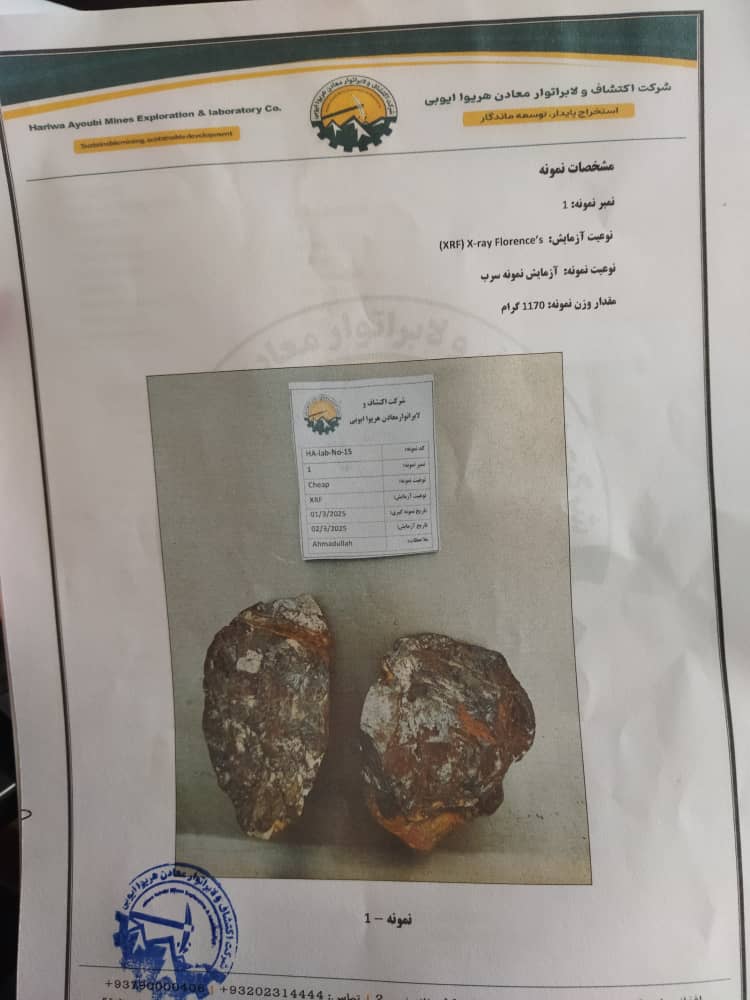
Sample ID: HA-Lab-No-15
Sample name / description: “1” – type of sample: lump ore
Sample weight for analysis: 200 g
Material form: Two hand-sized lump pieces, dark grey metallic with brownish weathering, typical of galena-rich material.
Sample receiving date: 2025-03-01
Analysis date: 2025-03-02
Analytical method: XRF (handheld x-met8000)
Summary
This report represents a bulk XRF scan of a representative lead ore lump sample from Afghanistan.
The data show a very high lead grade with a significant silver credit, supported by low to moderate levels of other metals and typical gangue elements.
Lab Result
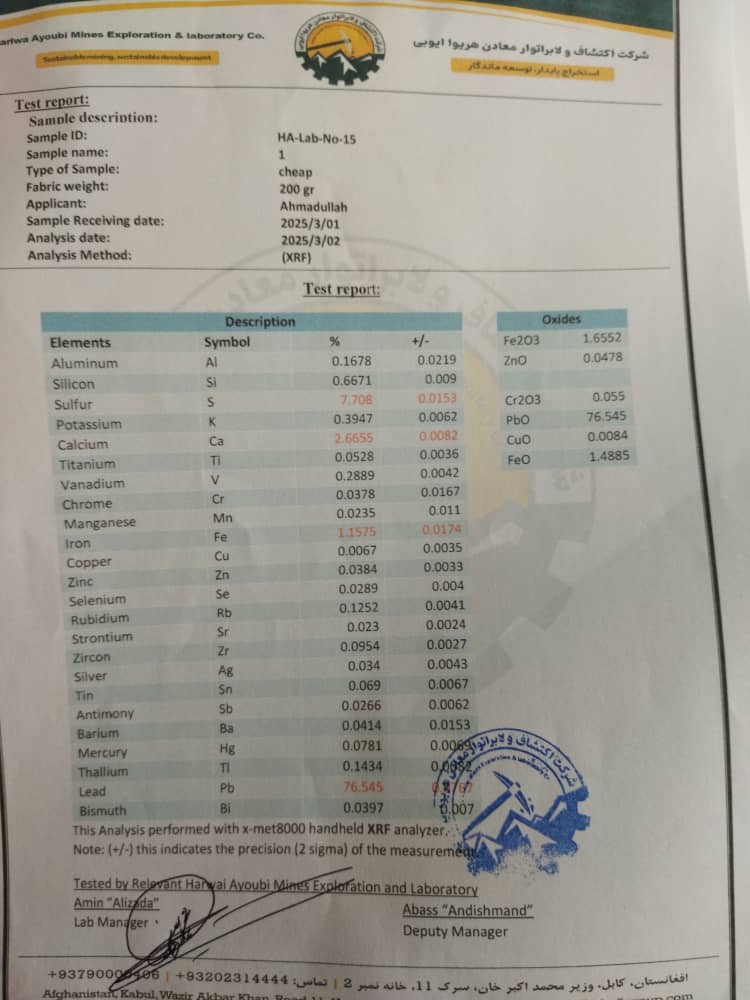
Chemical Composition
| Element | Symbol | Unit | Value (approx.) |
|---|---|---|---|
| Aluminum | Al | % | 0.168 |
| Silicon | Si | % | 0.667 |
| Sulfur | S | % | 7.708 |
| Potassium | K | % | 0.395 |
| Calcium | Ca | % | 2.664 |
| Titanium | Ti | % | 0.053 |
| Vanadium | V | % | 0.289 |
| Chromium | Cr | % | 0.038 |
| Manganese | Mn | % | 0.024 |
| Iron | Fe | % | 1.158 |
| Copper | Cu | % | 0.007 |
| Zinc | Zn | % | 0.038 |
| Selenium | Se | % | 0.029 |
| Rubidium | Rb | % | 0.125 |
| Strontium | Sr | % | 0.023 |
| Zirconium | Zr | % | 0.095 |
| Silver | Ag | % | ~0.03–0.04 |
| Tin | Sn | % | ~0.07 |
| Antimony | Sb | % | 0.027 |
| Barium | Ba | % | 0.041 |
| Mercury | Hg | % | 0.078 |
| Thallium | Tl | % | 0.143 |
| Lead | Pb | % | 76.545 |
| Bismuth | Bi | % | 0.040 |
Note: Key economic metals are shown in bold (lead as the main value metal, silver as by-product credit).
Economic Values
Main economic metal
-
Lead (Pb ≈ 76.5%)
-
This grade is characteristic of high-grade galena ore.
-
Pure galena (PbS) contains ~86.6% Pb; the reported value indicates rock that is mostly galena with some gangue and minor metals.
-
Valuable by-products
-
Silver (Ag ≈ 0.03–0.04%)
-
Equivalent to ~300–400 g/t Ag, which is a very attractive silver grade for lead–silver smelters.
-
Buyers would normally confirm this silver content using wet chemistry or fire assay before finalising commercial terms.
-
-
Tin (Sn ~0.07%) & Antimony (Sb ~0.027%)
-
Present at a few hundred ppm.
-
Not primary ore grades on their own, but in a large deposit they may provide small by-product value depending on the flowsheet.
-
Penalty / sensitive elements
-
Mercury (Hg 0.078%) and Thallium (Tl 0.143%)
-
These are environmentally sensitive and can attract penalties in smelter contracts.
-
Their presence must be monitored and disclosed during detailed negotiations.
-
-
Other elements such as Fe, Zn, Cu, Ba are at low levels and act mainly as gangue or minor impurities.
Market & Application
The chemistry and physical form indicate a high-grade lead ore suitable as feedstock for lead–silver smelters.
The lead content (~76.5% Pb) is the primary value driver, and the indicated silver content (~300–400 g/t) can provide a strong silver credit in typical lead–silver operations.
The ore is best suited for:
Primary lead smelters
Lead–silver refineries that can handle galena concentrates or high-grade lump ore
For international trading, buyers will typically require:
Confirmation of silver content, penalty elements (Hg, Tl), and moisture by accredited laboratories
Information on particle size distribution (if shipped as crushed ore or fines)
Consistent multi-sample data demonstrating that this grade is representative, not just a single exceptional piece.
Overall, the sample represents a commercially attractive high-grade lead–silver ore, provided that follow-up testing confirms similar quality across production lots and that penalty elements are managed within acceptable limits.
Disclaimer
Note: The above results refer to a specific laboratory sample (HA-Lab-No-15). Production material will be supplied according to agreed specifications based on multi-sample assays and contract terms.
Lead Ore Enquiry
Looking for reliable Lead ore supply? Contact us for grades, availability and logistics to your port.